Jump rope Tabata
Eight rounds of 20 s at your fastest pace, with 10 s of rest between them. Four minutes on the classic clock, and almost no time to recover.
A jump rope Tabata is eight rounds of 20 s of fast jumping with 10 s of rest between them: four minutes on the classic clock. It’s short and very hard. Use it to finish a longer session, or as the whole workout on a busy day. If you can jump for 20 s without stopping, you can do it. Beginners can take longer rests.
How the Tabata works
- 8 rounds of 20 s of work.
- 10 s of rest between rounds.
- 2:40 of work in all.
The classic Tabata clock reads 4:00 because it counts a rest after every round. Jump Rope Protocol shows 3:50: it drops the rest after the last round, and the work stays the same.
The name comes from Izumi Tabata. His team’s 1996 study repeated 20-second all-out bouts with 10 seconds of rest on a cycle ergometer, until exhaustion at the seventh or eighth. The rope version keeps that timing. One thing changes: on a rope, all-out stops where the trips start. Your ceiling is the fastest pace you can turn without missing.
How to do a jump rope Tabata
- Warm up first. The warm-up takes 3:50 and gets your feet in rhythm.
- Pick a pace you can hold for all eight rounds. Trained jumpers often sit at 120–140 jumps per minute and can push faster for 20 s. If you’re newer to the rope, 90–100 is a fair target.
- Stay light on the balls of your feet, with small jumps. Let your wrists turn the rope and keep your elbows close. Speed comes from the wrists.
- Breathe out in a steady rhythm, even when it gets hard.
- In each 10 s rest, keep the handles in your hands and the rope behind your heels, ready to swing. Take deep breaths and start the next round on time.
- If you trip, restart at once. In a 20 s round, a slow restart costs more than the trip itself.
A common mistake is a huge first round and a crash by round 4. Keep round 1 a notch under your limit, and try to match it in round 8.
Make it easier or harder
- Easier: take 20 s of rest instead of 10, or stop at four rounds. Slow to 90–100 jumps per minute. Use a basic bounce, or alternate foot so each leg gets a break.
- Harder: do a second Tabata after 1 to 2 minutes of rest. Switch to high knees for the last rounds, or to double unders if you land them consistently.
- Rope: a speed rope turns faster and allows higher counts. A heavier rope slows each turn and puts more work into your shoulders and forearms, so expect fewer jumps per round.
For a longer interval session at a pace you can hold, try Cardio 15.
In the app
Tabata is one of the app’s workout presets, which open from the Today tab. The app runs on iPhone and has an Apple Watch app. On the start screen, you can change the rounds, work and rest before you begin, for example to 20 s of rest on a tired day.
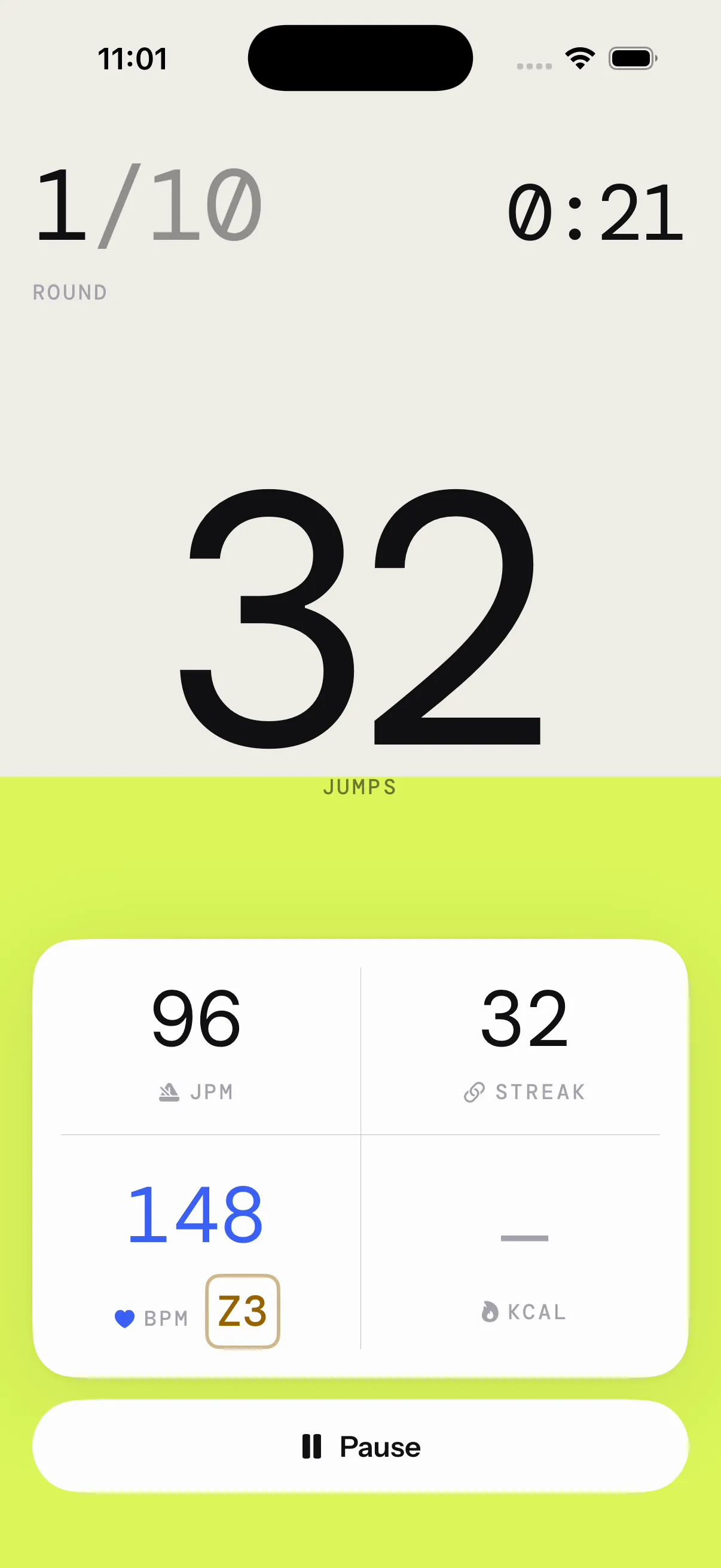
A countdown leads into round 1. Then the app runs the clock, and a voice calls each round, the rest and the time left, so you never need to check the screen. The app counts every jump with your AirPods, Powerbeats or Apple Watch, and the phone can stay on the floor. You get your cadence, your longest unbroken streak and every trip. Pair a Bluetooth heart-rate strap for live heart rate. Calories are estimated, and the session is saved to Apple Health.
The timer on this page runs in your browser. It beeps, but it can’t count jumps.
Your history keeps every session, and Progress shows your trends and records as you repeat the workout. The workout presets are part of Pro, paid once with no subscription.
Questions
- How long is a jump rope Tabata?
- Four minutes on the classic clock: 8 rounds of 20 s of work and 10 s of rest. Jump Rope Protocol shows 3:50, because it drops the rest after the last round. The work is 2:40 either way.
- How many jumps should I get in a 20-second round?
- It depends on your pace. At 90 jumps per minute, a 20 s round holds 30 jumps. At 140, about 47. Try to keep the same count from round 1 to round 8. A big drop means you started too fast.
- Is a jump rope Tabata good for beginners?
- It’s hard, because 10 s of rest is very little. If you’re new to the rope, start with 20 s of rest or four rounds instead of eight, on a basic bounce at 90–100 jumps per minute. Add rounds as your timing steadies.
- Where does the name Tabata come from?
- From Izumi Tabata, whose 1996 study repeated 20-second all-out bouts with 10 seconds of rest on a cycle ergometer, until exhaustion at the seventh or eighth bout. The jump rope version keeps the timing and swaps the bike for a rope.
- Can I do more than one Tabata in a session?
- Yes. Rest 1 to 2 minutes between blocks, and expect fewer jumps in the second block than in the first. Warm up before the first one.