How many jumps in a minute?
One minute, as many jumps as you can. Your count is your jumps per minute, and the number to beat next time.
The 1-minute test gives you your own number: as many jumps as you can in 60 seconds, on one clock, with no rounds and no rest. The count you finish with is your score, and it’s also your jumps per minute. For a sense of scale, steady training paces usually sit near 90 to 100 jumps a minute for beginners and 120 to 140 for trained jumpers; an all-out minute runs above that. Take it once for a baseline, then retest every few weeks under the same conditions to see if you’re getting faster. Any level can take it, because the only target is your last score.
How it works
- One clock: 60 seconds.
- One rule: as many jumps as you can. No rounds, no rest.
- A trip doesn’t stop the clock. Start again and keep going.
- Your score is your jump count, which is also your jumps per minute.
- Retest every few weeks with the same rope, on the same surface, after the same warm-up. Change one of them and you’re no longer comparing like with like.
How to do it
- Warm up the same way every time. The warm-up makes a good fixed routine. End it with two or three fast 10-second bursts, so the test isn’t your first fast jumping of the day.
- Choose your footwork, two-foot bounce or alternate feet, and keep it from test to test.
- Start with the rope behind your heels and your hands at your hips, ready to go on the first second.
- Go out fast, not flat out. Find the quickest rhythm you can hold, keep it through the middle 30 seconds, and give everything in the last 15.
- Keep the jumps small. At speed, the rope needs only a small gap under your feet. Stay on the balls of your feet, wrists turning the rope, elbows tucked, shoulders low.
- Keep breathing. A minute is short enough to hold your breath without noticing. Breathe out in short, regular bursts.
- If you trip, don’t look down at the rope. Reset your hands and go. Every second you stand still costs you jumps.
- Note your score, the rope and the surface.
Make it easier or harder
To make it easier:
- Test 30 seconds instead of 60.
- Jump the minute at a steady pace you could hold for longer, to learn the rhythm before you go all out.
To make it harder:
- Test 2 or 3 minutes, to see how long you hold your speed.
- Test alternate feet at full speed.
- Use a heavier rope, and keep its scores apart.
Each version is its own test, and so is each rope: pick one and run it the same way every time. For a test that climbs until your speed runs out, try Death by.
In the app
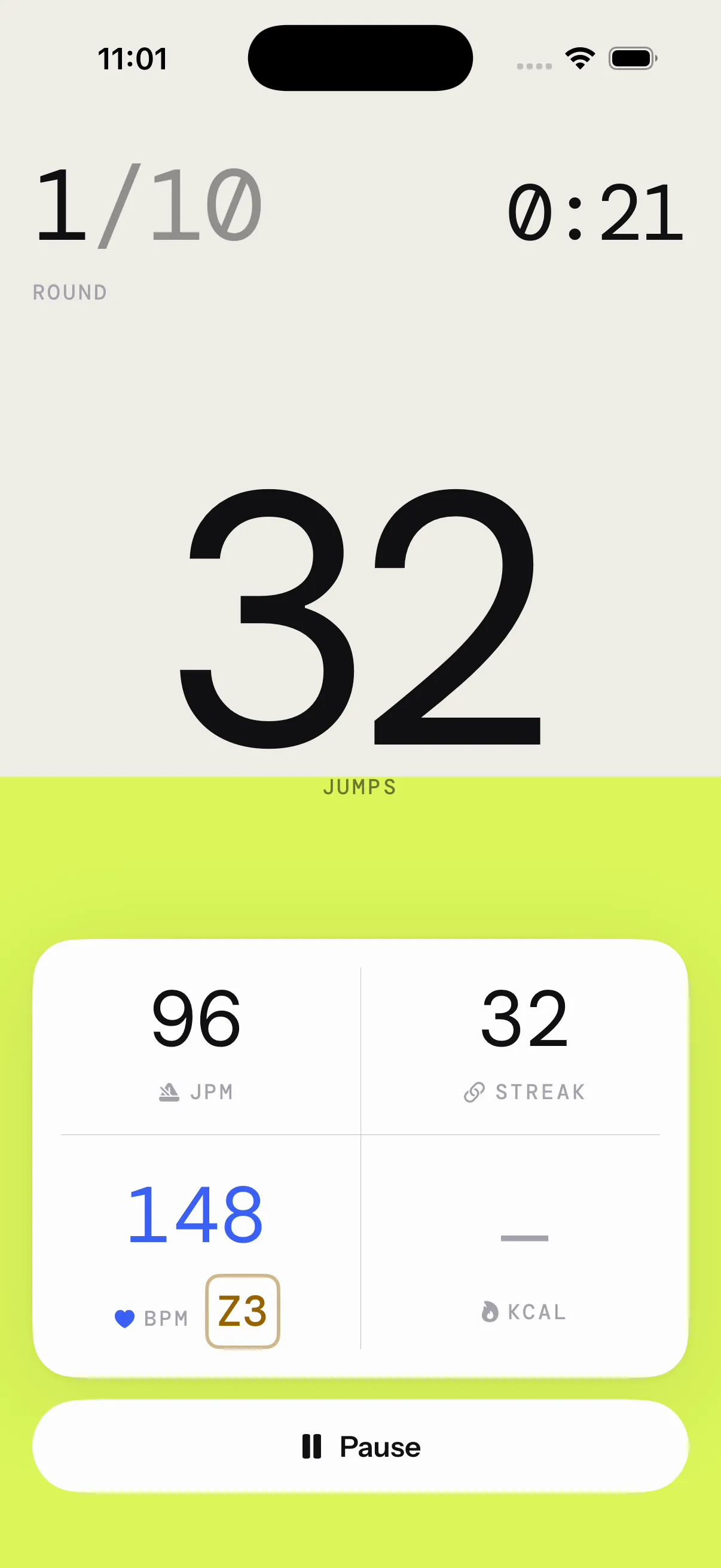
In Jump Rope Protocol, the 1-minute test is one of the workout presets on Today. A countdown puts you on the rope, then the app counts every jump with your AirPods, Powerbeats or Apple Watch while the phone stays on the floor, and the voice tells you the time left. It tracks your cadence, your longest unbroken streak and your trips. Every test stays in your history, and Progress shows your trends and records, so each retest lands next to the last one. You can change the length before you start, to 30 s or 2 min. The presets are part of Pro, paid once, with no subscription.
This page’s timer runs in your browser and keeps the 60 seconds. A browser can’t count jumps, so have someone count for you, or film yourself and count afterward.
Questions
- How many jumps in a minute is good?
- There’s no single good number. Steady training paces usually sit near 90 to 100 jumps a minute for beginners and 120 to 140 for trained jumpers, and an all-out minute runs above your steady pace. The number that matters most is your own from a few weeks ago, taken with the same rope, on the same surface, after the same warm-up.
- How often should I retest?
- Every few weeks. Keep the rope, the surface, the warm-up and the footwork the same each time, so the change in your score comes from you.
- Do trips count against me?
- They cost you the seconds it takes to start again, because the clock keeps running. Reset your hands and go straight back in.
- Should I use a speed rope for the test?
- Use the rope you train with, and keep it for every test. A light speed rope turns faster than a heavy one, so compare a rope only with itself.
- Is my 1-minute score the same as my cadence?
- It’s your jumps per minute for one all-out minute. Over a longer session, your average cadence sits lower, because you can’t hold an all-out pace for long.